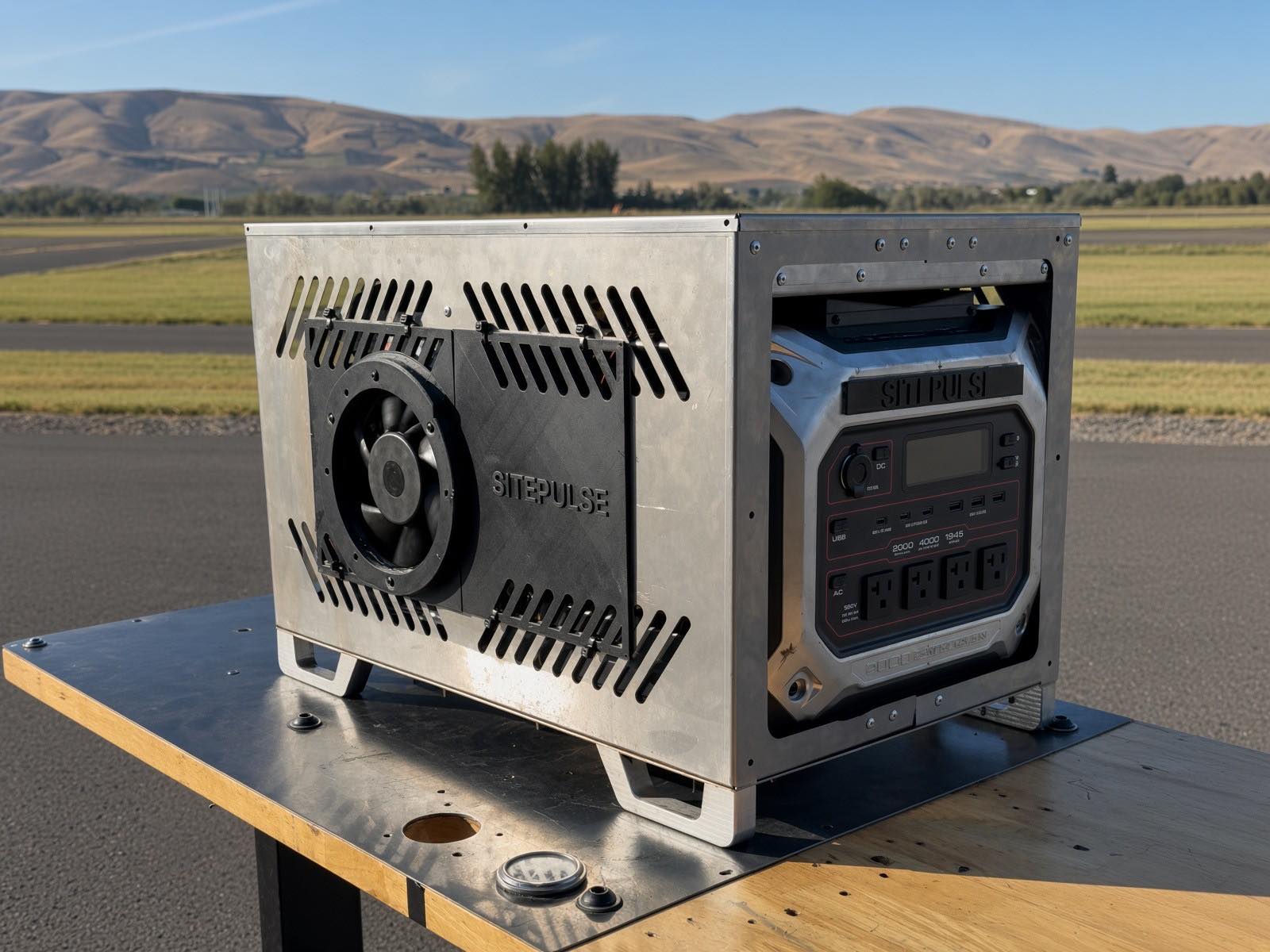
A 90-lb hybrid power station — 4,000 W pure-sine inverter, Starlink Mini, and a top-up 170 cc engine. Battery handles daily loads. The engine only kicks in 23 minutes a day.
The hybrid stack swaps power source automatically — silent battery first, Starlink always connected, the engine only when load truly demands it. No switches. No downtime.
30 Ah lithium iron phosphate at 48 V nominal, 22 lb with active BMS. Cell-level protection, optional sub-zero heaters. Runs Starlink Mini for 40–48 hours of pure silence between starts.
Dish, router, and cable all inside. Powered on a dedicated circuit (or optional direct DC for max efficiency). Cellular failover keeps telemetry alive if Starlink ever drops.
Gas twin paired with a high-output starter generator delivers up to 10–12 kW on demand. Auto-starts when load exceeds the inverter for 45 s; otherwise idle. External quick-disconnect fuel tank — no built-in tank, no spillage.
Connectivity-only mode: a Starlink Mini at ~25 W average. The control board tracks load, state-of-charge, and fuel — and starts the engine only when it has to.
Starlink Mini pulls ~25 W. Engine off. Pack drains roughly 1% per hour. Site at zero decibels.
Day-one finishes at ~60% SOC. The control board is happy. Telemetry beats home every minute.
Pack hits ~25%. Engine warm-start, idles up, generator picks up the load while the pack tops off.
Pack back to ~90% in 23 minutes. Cooldown sequence runs. Stabilizer doses on shutdown. System silent again.
~13 gallons consumed per month. ~12 hours of total engine runtime. The other 97% of the time: silence.
Months of unattended uptime on a single fuel tank. Engine runs ~12 hr/month. Every reading hits the cloud over Starlink, with cellular failover for telemetry.
Powers Starlink Mini, a logger, and a couple of cameras 24/7. Silent enough to live next to a tent. Refuel cadence: weeks, not days.
PTZ camera + AI box + Starlink. Runs through a smoke event without intervention. Manual override available from the app if the duty cycle needs forcing.
Lift it off the truck, plug in the external tank, raise the dish. Internet and a 120 V outlet within 90 seconds. Up to 12 kW available when crews arrive.
Drives flow meters and a Starlink uplink for an entire well pad. Engine duty stays under 2%. Stabilizer auto-doses on shutdown for long sits between visits.
~25 W of Starlink lasts 40-plus hours on battery alone. Plug in tools or a fridge and the engine joins in automatically. No switches to flip.

| Battery | 30 Ah · 48 V LFP (1.54 kWh) · 22 lb · active BMS · cell-level protection |
|---|---|
| Inverter | 4,000 W continuous · 8,000 W surge · hybrid w/ generator input · 120 V pure sine · 60 Hz |
| Engine | DLE 170cc twin-cylinder gas · 17.5 HP · 9.1 lb · vibration-isolated mounts |
| Starter generator | High-output starter/alternator · up to 10–12 kW peak · VESC controller |
| Connectivity | Starlink Mini integrated (3.5 lb kit) · cellular failover · OTA firmware |
| Fuel | External quick-disconnect tank · gasoline w/ auto-stabilizer dosing on shutdown |
| Sensors | Ultrasonic fuel level · SOC/V/I/temp · CO · enclosure temp · GPS |
| Chassis | SendcutSend sheet metal enclosure · IP65 · 8 lb · integrated carry handles |
| Environment | −20 °C to +50 °C (heaters optional) · <60 dB(A) enclosed · vibration-isolated |
| Safety | CO shutdown · fuel cutoff · BMS protect · GFCI · surge · local + remote E-stop |
| Total weight | ~90 lb dry (no fuel) · realistic 85–92 lb range |
It just sits there and stays online. We checked the dashboard, not the unit, for a full month.
~13 gallons a month for a Starlink uplink and a logger. The math finally works for our pads.
Engine started when it said it would, ran for 23 minutes, and went quiet again. Boring. Good.
The DLE 170 + high-output starter generator can deliver up to 10–12 kW on demand — Level 2 charging speeds in a 90-lb box. Stranded twenty miles from town? Plug in. Be moving in under an hour.
Reserve with $100 today. Build slot locks in. Balance due before Q3 ship date. Refundable until 30 days before fulfillment.